Choose the Perfect Domain Name for Your Blog in 2025 (Step 3 of Your Start-a-Blog Roadmap)
A complete, beginner-friendly guide to choosing the right domain name for your blog in 2025. Learn naming rules, branding tips, extensions, mistakes to avoid, availability checks, and how to pick a domain that supports long-term growth.
A domain name is not just what people type into their browser; it is the identity, address, and long-term brand foundation of your blog. Choosing the right domain early will save you from rebranding later, prevent confusion for your readers, and help your SEO and credibility from day one.
This guide explains everything clearly and calmly, with examples, templates, and visual mockups that make the decision straightforward for absolute beginners.
What is a domain name?
A domain name is your blog’s permanent address on the internet:
- yourblog.com
- travelwithsam.com
- everydayrecipes.in
- thefinancedesk.net
When someone visits your blog, they type or click your domain name.
A simple visual explanation:
- Domain Name: Your online address
- Hosting: Storage for your website files
- Platform (WordPress): The engine powering your blog
- Design: How your blog looks
In this step, your only task is to choose the best possible domain name. You will buy it in Step 4.
Before choosing your domain name, ask yourself two questions
These two answers shape everything else.
1. What will your blog be about?
Examples:
- personal finance
- travel
- parenting
- fitness
- food
- personal brand
- multi-topic blog
You don’t need a final niche yet, but you need a sense of direction.
2. Do you want a brand or a personal space?
A brandable domain is future-proof. A personal domain (your name) is better for coaching, consulting, and portfolios.
This decision guides the naming style you’ll choose.
What makes a great domain name?
A strong domain name has four qualities:
1. It is easy to remember
Short, smooth, and clean.
2. It is easy to type
Avoid:
- double letters
- unusual spellings
- hyphens
- numbers
3. It is short
Ideally 8–15 characters, though not mandatory.
4. It is brandable
It should feel like a name people can say aloud naturally.
Examples of brandable names:
- DailyNest.com
- TravelPath.com
- SimpleParenting.in
- TheTechChapter.net
Names to avoid:
- besttraveldealsindia2025.com
- cooking-recipes-online123.com
- health_blog__india.info
Which extension should you choose? (.com, .in, .net)
Extensions matter more than most beginners realise.
.com
Best choice globally. Short, easy to remember, and highly trusted.
.in
Excellent if your audience is mainly in India. Short, clean, and good for SEO in India.
.net
Acceptable when .com is taken, especially for tech, tools, and developer content.
Others (.blog, .site, .online, .info, .co)
Not recommended for beginners. These feel less authoritative and can make branding harder.
If possible, choose:
- .com
- .in (if India-focused)
- .net (only when suitable)
Step-by-step process to choose the perfect domain name
Here is the exact workflow professional bloggers use. Follow it in order.
1. Select your naming style
There are seven naming styles that work consistently.
Style 1: Keyword + modifier
Examples:
- budgettravelguide.com
- simpleparentingtips.com
Great for clarity.
Style 2: Two-word brand
Examples:
- BrightNest.com
- TravelPeak.com
- MindStudio.in
Easy to remember and good for long-term branding.
Style 3: Single-word brand
Ideal but difficult to secure. Examples:
- Medium
- Notion
- Hubspot
Style 4: Personal name
Examples:
- anitawrites.com
- samuelkumar.in
Best for portfolios or coaching.
Style 5: Invented niche-based words
Examples:
- Fitella.com
- Parentory.com
Modern and flexible.
Style 6: Action-based names
Examples:
- LearnCodingFast.com
- SaveMoreMoney.com
Clear purpose.
Style 7: Community-based names
Examples:
- creatorscircle.com
- familywellnesshub.com
Good for blogs that may turn into communities.
2. Use naming templates
Finance
- {simple}{money}.com
- {smart}{budget}.com
- {clear}{finance}.com
Examples: simplemoneylab.com, clearfinanceguide.com
Travel
- {yourname}{travels}.com
- {wander}{word}.com
- {global}{path}.com
Parenting
- {calm}{parent}.com
- {family}{stories}.com
- {parenting}{guide}.com
Tech
- {code}{word}.com
- {dev}{hub}.com
- {tech}{insights}.com
Food
- {simple}{kitchen}.com
- {daily}{recipes}.com
You can use these templates to generate dozens of ideas.
3. Brainstorm 50–100 ideas
Aim for volume first. Most names won’t work — that’s normal.
Example brainstorm list:
Finance: SaveNest.com, BudgetCraft.com, MoneyDen.com Travel: WanderPeak.com, GlobalSteps.com Food: KitchenNotes.in, EasyMealStudio.com Personal: RahulWrites.com, AnitaBlog.com
This is your raw material.
4. Check domain availability
Search your shortlisted names on:
- Namecheap
- GoDaddy
- Hostinger Domains
- Google Domains (if available in your region)
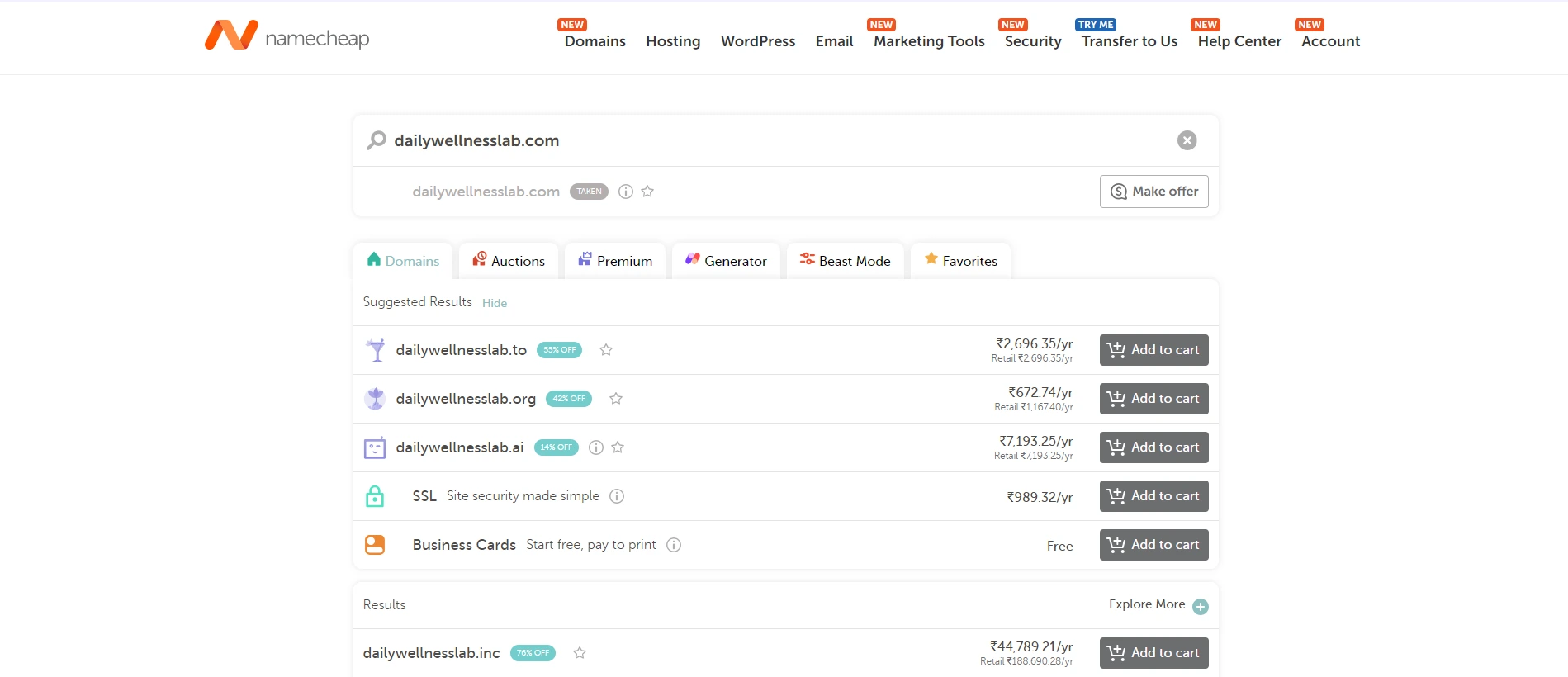
What to check:
- Is the exact
.comavailable? - If not, is
.inavailable? - Is the price normal (₹700–₹1,200/year)?
- Avoid premium-priced domains unless building a commercial brand.
5. Check legal and trademark conflict
This step prevents problems later.
Check:
- Google search
- MCA India business database
- Global trademark database (optional)
Avoid names similar to known brands in your niche.
For example:
- nikefitnessguide.com → absolutely avoid
- fitnest.com (too close to “fitness”) → avoid
- fitnesthub.com (safe) → acceptable
Make sure there is no brand confusion.
6. Check social media handle availability
Search the name (without hyphens) on:
- YouTube
- X/Twitter
You don’t need all platforms, but ideally:
- Instagram handle available
- YouTube handle available
- Domain name not widely used by someone else
This ensures clean branding later.
7. Make your final selection
Use this checklist:
- Is it short?
- Is it easy to spell?
- Is it brandable?
- Does it work for at least 5–10 years?
- No trademark issues?
- Social handles available?
.comor.inavailable?
Choose the name that meets most of these, not necessarily all.
Good and bad examples for comparison
Good
- travelwithsam.com
- mindfulbudget.com
- thetechchapter.com
- simplewellnesshub.com
Weak
- thebesttravelblogoffers2025.com
- cooking-recipes-online123.com
- health_blog_info.xyz
Common mistakes to avoid
Avoid the following:
- hyphens
- numbers
- very long names
- names that restrict future growth
- names too similar to an existing company
- difficult spellings
Example:
“ketodietrecipesindia.com” is too narrow. Better: “everydaywellness.in”.
How many names should you shortlist?
Three is ideal.
- Primary choice
- Backup option
- Brand-style wildcard
Run all three through every check.
A simple decision flow (visual mockup)
- Check .com
- If not available → check .in
- Reject names with legal conflicts
- Confirm social handle availability
- Shortlist 3
- Select the strongest long-term choice
A quick 5-minute activity
- Write your blog’s main topic
- Choose your naming style
- Generate 20 ideas
- Search availability
- Shortlist 3
In Step 4, you will purchase the domain.
People Also Ask (FAQs)
What is the best domain extension for a blog?
.com if available; .in if India-focused.
Should I use my real name as my domain? Yes, if you are building a personal brand, portfolio, or coaching blog.
Do keywords help in domain names? They can help, but brandability is more important.
Should I buy multiple domain extensions? No. One is enough for beginners.
What if the domain I want is taken?
Try synonyms, two-word brands, or alternative extensions like .in.
Next step
You have now shortlisted or selected your domain name. In the next step, you will choose a web hosting provider and connect your domain to it.
Proceed to Step 4: Choose Your Web Host